
De-monomythizing
By Anthony Casperson
4-25-26
While some might chalk it up to an attention bias or some sort of illusion in frequency, I’ve heard multiple people speaking about the same general topic lately. Despite the fact that the concept has been a common thought in western culture, there seems to be a current revival in conversation about this from multiple, unrelated sources.
The topic in question has to do with thoughts about how certain stories or aspects of philosophy are common throughout various cultures and mythologies. Creation stories, flood narratives, resurrection tales, and even the concept of an afterlife, all pop up among numerous people groups, from different times and places. These commonalities happen often enough that we can categorize them based off of those narrative aspects.
Categorization like this isn’t necessarily bad. But what I’ve also noticed that happens lately, every time this topic has reared up, can certainly lead that direction. The speaker will mention the category to which this specific story belongs with a dismissive attitude, and then will use the fact that it fits some level of categorization to deny any need of looking deeper into the story to understand it. Essentially saying, “It’s a ________ narrative. That’s all I need to know about it.”
Often, this also comes with a dismissive attitude of, “Well, they can’t all be true, so none of them are true.”
The reason why this chain of thought creates a negative discussion is because it makes the descriptive similarities become a prescriptive interpretation. It causes us to move from considering a level of kinship, to a declaring that what is true of one must be true of everything like it.
It dogmatizes the categories. And then, refuses to let anything exist outside of those lines that were forced upon it by external entities.
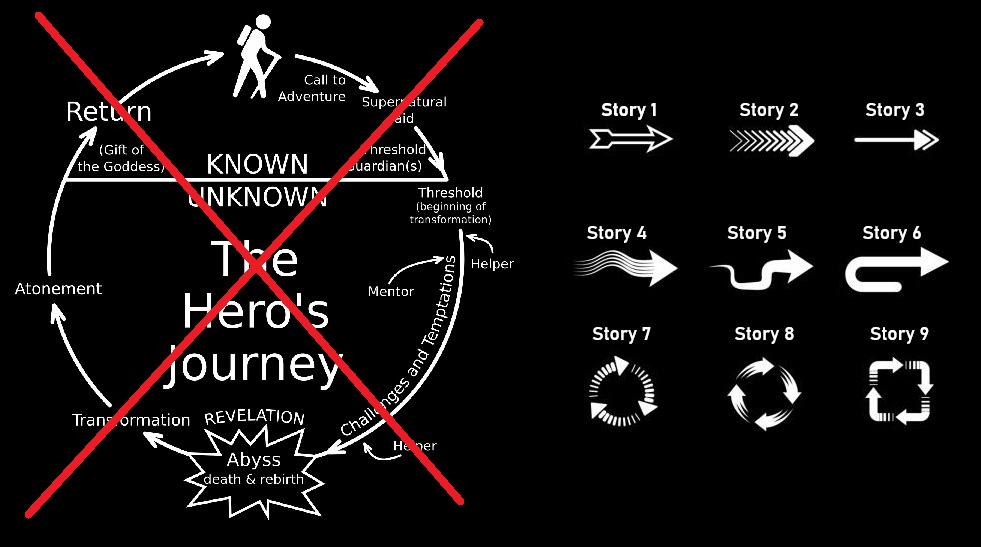
This shift from descriptive to prescriptive isn’t anything new to stories. It happens far too often when speaking of Joseph Campbell’s monomyth. This is the view that all stories fall under the same sequence of events, no matter the time or culture telling it, often referred to as the hero’s journey.
Some—including Campbell himself, in my opinion—hold so strongly to this categorization of story sequence that they force plot points into their paradigm when those parts of the actual story are saying something entirely different than what the preconceived pattern claims.
They’re looking for any hint of the hero liking their previous life in order to call it the “Refusing the Call” step. Every person in authority becomes a possible father figure for the “Atonement with the Father” phase. They “monomythize” every story to exactly the same. And thus, strip the important essence of a story from the telling.
Various cultures value different aspects of human existence. Even though there might be some universal essence of what it means to be human, how we express that commonality carries different nuances. Therefore, when we attempt to monomythize the stories, our prescriptive dogma neuters the whole point of the story.
And more importantly for my point in this blog, the attempt undercuts the ability for a story to be true, just because it fits the categorization.
If a person wishes to relate their real-life experiences, but the sequence of events just happens to follow the monomyth, does that automatically dictate that they were making up some, or all, of it? Does the fact that the main character of the true story could fit into the classic category of “hero” mean that this characterization is automatically fictional?
No. A similarity in description doesn’t prescribe the story’s reality.
The purpose of telling the story, the details of the narrative, and the truthfulness of the author—or lineage of the story’s tellers, for older examples—all provide more for the veracity of the story than the category into which we place its description. The more we can trust those aspects, the more likely the story is true. It has nothing to do with what category we could arbitrarily place it in.
Say that a person whose not known for exaggerating goes fishing. When they later tell their friends the story about a fish that got away, saying it was “this” big, their audience isn’t going to act like they’re telling a “big fish tale” just because it fits in the category. The purpose, details, and author make the difference.
This is why it’s important for those of us who have faith in the God of the bible to look to his word with an understanding of its history. We can have greater trust in its truthfulness because of how close to the source the manuscripts we have access to are. (Something that is more true of the bible’s words than any other story that fits in similar descriptive categories.) It allows us a greater chance to trust the author’s words.
If we want to search deeper into aspects that we actually can see for ourselves, we should look at the details and the purposes of the stories and their counterparts.
Take flood narratives, for example. Details of the bible’s story show that the flood was as a result of judgement against humanity. But because of God’s mercy, it wouldn’t be a total wipe out of the species. And, when the flood was over, God’s reaction was also one of mercy, the promise of never again destroying the earth by flooding it. The rainbow became a sign of this covenant.
And so, we can see that the purpose of the biblical narrative is to reveal God’s justice alongside his mercy. There are consequences for sin. Terrible consequences. But he continues to desire relationship with his creation, so much that he’s willing to limit his own actions and make covenant promises with them. (We can also see that these aspects of God’s being are repeated throughout the bible.)
However, other flood narratives often reveal far more capricious deities. Mesopotamian mythologies show the gods being annoyed at the noisy humans. They’re like passive-aggressive neighbors who fall to nefarious deeds in order to get those hooligans next door to just shut up. And then, after the flood is over, they’re clamoring like flies for the smoke of the only humans’ sacrifice because they’re starving for it. Such a tale shows how reliant upon those noisy humans that the Mesopotamian gods are.
In a slightly different direction, Chinese mythology’s flood narrative—or, one of its flood narratives, which is the discovery I had when I finally decided to write this blog—is shown as part of the cyclical nature of order vs. chaos. It’s the continual presence of give and take that is prevalent in Chinese philosophy and belief. There’s not even really a purpose in this world-wide flood, just a cosmic imbalance of chaotic energies that needs to be returned to order again. Until the next time that the cosmic cycle raises chaos up again.
Speaking of cyclical events, we can quickly look at one other of these categorical narrative types: resurrection stories. I use the cyclical connection because that’s what the vast majority of stories use resurrection for. Those storied resurrections are tied to rhythmic patterns, like a day/night cycle or the year’s seasons. The death and resurrection is something that needs to be done over and over again.
However, biblical resurrection—specifically Jesus’ resurrection—has very different details. His death, burial, and resurrection are a one-time event that is for all who trust in his sacrifice.
As a matter of fact, New Testament authors point to the importance of that once and for all sacrifice. The idea that his death would need to be done a second time actually puts into question the efficacy of the first. If there’s some part of sin that his sacrificial death failed to cover the first time, then why would we trust any of it at all?
Looking at the purpose, the details, and the author allows us to see that there’s a drastic chasm of difference between these stories. Despite the fact that we’d put in the same category, merely because of a few concepts might kinda sorta look similar. Although, only when you squint in a dark room while standing on your head.
To disbelieve one merely because we’ve monomythized them all betrays our arrogance in the external categories that we’ve prescribed to them.
And while I might have my own reasons for believing one story to be true over the other, I’m not asking you to agree with me on which one is true. But rather, join me in looking at the details, purpose, and author of the story instead of just relying on our prescribed monomythizing.
Don’t make a categorical error merely because there’s some similarity in the descriptions. De-monomythize the stories. Return the categories to descriptors. And maybe then, we’ll come to discover the truth.
Or, at the very least, let the story show us what it wants to say about reality around us.