The Pupil’s Pupil
By Anthony Casperson
8-29-26
Numerous stories show a parent telling their child to not go to a certain location. Steer clear of there because it’s dangerous. The one who lives there isn’t friendly. You could get hurt, if you go anywhere near that place.
The woods just outside of the village. The creepy old house at the edge of town. The surface of the ocean. The elephant graveyard. All are places that a character has been told to not go anywhere near.
And yet, the characters almost always fail to listen to their parents. They go, and discover great pain and tragedy because of that failure to listen. Sure, a handful find good things as well along the way. But almost all of them end up with physical or emotional scars from not listening to their parents.
The point of the stories isn’t meant to teach children to disobey their parents’ wishes. Rather, they’re intended to show that there is wisdom in the warning. Danger does exist. Pain and difficulty arises there.
And often it requires help external to the protagonist in order to overcome the danger. The parent has to come to the rescue. Or friends arrive to help. Sometimes, it’s purely a divine blessing that intercedes.
The point is that while curiosity may be a neutral thing in and of itself, wisdom is required to properly direct the curiosity away from danger.
Over this blog series—which has extended a little beyond summer, and will continue for a couple more weeks—we’ve continually seen Solomon speak to his son and those of us willing to learn about the value of wisdom. Godliness that we should focus our attention and lives on, rather than the foolishness of anything contrary to the ways of God.
While Solomon continues that trend of wisdom for this blog touching on Proverbs 7—because that’s kinda the point of the series—for this chapter, he adopts a storyteller’s guise, speaking of an innocently naïve person whose curiosity about danger is met with a deadly end.
Again, the idea isn’t to tell us of curiosity’s dark side, but rather to showcase how wisdom is needed as well, in order to keep us from danger.
Solomon’s opening to this lesson starts very much like the other lessons have. He calls his son—and us—to guard and treasure wisdom. The commands and teachings of godliness are the very things that guide our understanding of how to properly fear Yahweh.
But right at the end of verse 2, we get a new term to this discussion, which will come back to again later in a hidden location because of translation issues. This term is the “apple of your eye.”
The general sense of the word is the pupil. It continues the idea of direct focus. Because where your pupil is pointed, that’s where your focus lies.
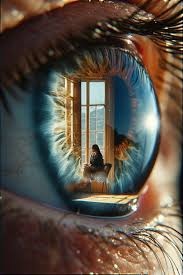
However, the Hebrew has an almost poetic quality to it. The word seems to be built off of the word for “man.” And this might be confusing, until we think about what happens in an eye when it’s staring at a person. There’s a little, tiny reflection of that person in the eye. So, in the pupil, others can see the reflection of the little man who is our focus.
While Solomon calls for his son—his student—to keep godly teaching as our focus, he’s also reminding us that others can tell what we’re focusing on as well. It’s as obvious as the little man reflected in your pupil.
Or, in the case of the metaphorical person of Folly, the little woman in your pupil.
In verse 4, Solomon calls us to let that little reflection be of Lady Wisdom rather than Folly. Our closest ally, our most beloved friend, our emergency contact, our kinsman redeemer—the one who gets us out of all difficulty and danger—should be Lady Wisdom. She’s the one who keeps our curiosity from the danger of foolishness.
With Lady Wisdom as the little woman reflected in our pupil, Folly will never take her place.
The only way that Folly will become the little reflected woman is if we reject wisdom as the central focus of our lives. When we let the curiosity of the places that we shouldn’t go lead us directly to her.
Solomon begins his storytelling in verse 5. He speaks of a once upon a time, that he’d seen while looking through the shades of his window.
There was a young person—one referred to as simple—who thought he was being sneaky while heading to the dangerous zone. But this naïve person was clocked by Solomon as one who had let Folly become the reflection in his pupil.
Lest we trip over the comment of the person being simple or naïve, let’s discuss what this means. It’s not supposed to be a derogatory statement. He’s not making fun of the youth. Rather, this is a term for one who innocently didn’t understand the danger he was heading toward.
Simple doesn’t mean stupid, here. It’s more about a lack of understanding of the danger. The naïve is one who’s view of the world around them lacks the perspective of wisdom.
Verse 7’s statement of the young man lacking “sense” doesn’t mean the guy has a lot of empty space up in the brain. Literally, the Hebrew speaks of a lack of “heart.” There’s not the conviction of a heart devoted to godliness.
The one whom Solomon sees head toward Folly isn’t a bad person. Just one who desperately needs to attend the classes on wisdom.
But again, this naïve person isn’t accidentally heading toward the danger of Folly. No, he knows enough to understand that others call this place dangerous. The woman, Folly, is not one to make deals with. Yet, he takes a route that leads to her house. In the darkness of night so that no one knows he’s going there.
No one except the one who sees the reflection in the young man’s pupil.
See, in verse 9 the word for “apple of the eye” or “pupil” again shows up. We just translate it as “time” or the “middle” of the night. But the problem is that we then miss out on the fact that the simple person’s focus is being contrasted with the reflection of wisdom that should be in our eye.
This midnight rendezvous with Folly is what happens when we divert our focus away from Lady Wisdom, and let foolishness take her place. It’s when we allow our curiosity to lead us to danger.
And danger is exactly what Folly is.
Verses 10-21 show us Folly’s trap being set for her prey. She’s dressed in the provocative clothing of a prostitute, even though that’s not her job. Despite the fact that she’s married, she wanders about town, looking for those too young and naïve to realize they’re being prepared for dinner.
She wants the attention. Draws it on purpose. And does it blatantly, out on the street for any to see in the darkness of night that she’s unfaithful to her husband, as she kisses the young man.
Not only is she unfaithful to her husband, but also to God. Look at verse 14. She says that she’d offered sacrifices and paid vows that day. Such sacrifices were the type where the one offering the sacrifices also took some home. And the meat needed to be eaten that night. In the morning, it would be unholy to partake of.
The woman Folly is using spiritual-sounding things to lure the young naïve man in. She’s saying that she has all of this holy meat to partake of and no one to help her eat it. The young man would be doing her such a favor if he only joined her for a meal. And a holy one at that, see?
Foolishness can even look like a good and godly thing for those who lack wisdom. Those who remove their focus from the fear of Yahweh—those who don’t learn what his ways and commands are—can be lured in by the seemingly godly things of foolishness.
False teachings and the lie of godless spirituality will not lead to the life of wisdom.
Eventually, the truth of the godless ways will arise. As we see in verses 16-19 where Folly tempts with pleasures that go beyond God’s commands. She whispers her preparations of fine linen on her lounge. Scented with aromas of rich sensuality.
And then she flat out speaks of having sex for the whole night, taking full pleasure with one another’s presence. She even tries to calm any worries that the young naïve man might have about Folly’s husband returning home. He’d left recently, with a lot of money, and business so far away that he won’t be back for a couple of weeks. “We have all the time we need to fully explore one another,” she says.
But this is all just to lure the naïve man into her trap. It’s the temptation that leads to the slaughter. Verses 22-23 show us that he was never meant to be more than another victim. Another life stolen and consumed by Folly.
The little woman in the pupil of his eye ripped it out, and tore into the rest of him as soon as she could.
And so, Solomon the storyteller ends his tale with the moral of the story in verses 24-27. Learn from that simple and naïve young man who’d been captured. Don’t head down that street. Don’t turn near that corner. It’s dangerous there.
If we allow our curiosity to remove Lady Wisdom as the little woman reflected in the pupil of our eyes, then the same thing might happen to us.
Let’s learn from the story of the young man who fell victim to Folly. Keep Lady Wisdom as the one reflected in our eye. Because then we need not fear the consequences. Wisdom is only interested in bringing us life. The proper understanding of the ways of Yahweh will keep us away from the danger.